Honeydew (melon)
A smooth-rind melon known for its pale green flesh.

Fumikas Sagisavas · CC0
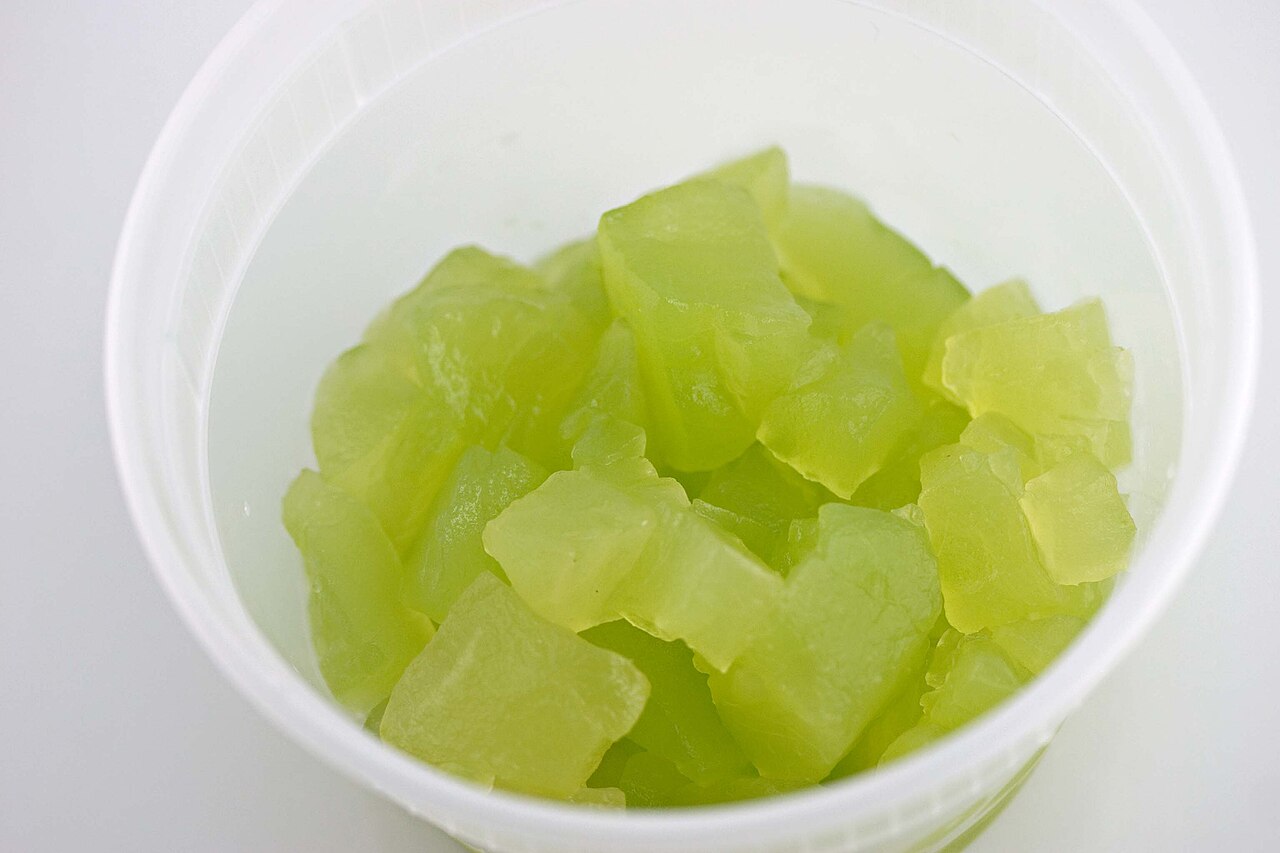
The honeydew melon is one of the two main cultivar types in the Cucumis melo Inodorus Group, characterized by its smooth, often green or yellowish rind and lack of musky odor. It is widely cultivated and consumed around the world, commonly found in supermarkets alongside cantaloupe melons and watermelons.
- type
- Cultivar type
- group
- Cucumis melo Inodorus Group
- typical_length
- 15–22 cm (5.9–8.7 in)
- typical_weight
- 1.8 to 3.6 kg (4.0 to 7.9 lb)
- water_content
- 90%
- calories_per_100g
- 36
- season_in_California
- August until October
Lore & Background
The honeydew melon is a broad type within the Cucumis melo Inodorus Group, not synonymous with any single cultivar such as the French White Antibes. In China, honeydews are known as Bailan melons and are famous locally near Lanzhou, the capital city of Gansu province. According to some Chinese sources, the melons were introduced to China by American Secretary of Agriculture Henry A. Wallace, who may have provided seeds during a diplomatic visit in the 1940s, though this specific claim is not consistently supported by widely-documented historical records.
Reader's Guide
The honeydew melon is significant as a major cultivar type within the Inodorus Group, distinguished from the wrinkle-rind casaba melon. Its cultivation is best suited to semiarid climates, and harvesting is based on maturity rather than size, judged by rind color shifting from greenish white to creamy yellow, as well as by the blossom-end yielding when pressed and a pleasant aroma. Quality is determined by a nearly spherical shape, a surface free of scars or defects, a heavy feel for its size, and a waxy rather than fuzzy surface. Nutritionally, the honeydew is 90% water and an excellent source of vitamin C, providing 56% of the recommended daily value per cup, along with vitamin B thiamine and potassium, while being low in calories at 36 per 100g. Its introduction to China by Henry A. Wallace led to the local nickname 'Wallace' (Hualaishi), and it is known by various names among different peoples, including Hmazil (Mizo), Chindire (Garo and Chakma), Te'e (Tanchangya), and Melón tuna in parts of Latin America.
Did You Know?
- The honeydew melon is one of the two main cultivar types in the Cucumis melo Inodorus Group, the other being the wrinkle-rind casaba melon.
- In China, the honeydew is known as Bailan melon and is sometimes called 'Wallace' (Hualaishi) after American Secretary of Agriculture Henry A. Wallace, who reportedly introduced the seeds during a 1940s diplomatic visit.
- The honeydew is 90% water and contains only 36 calories per 100g.
- In some parts of Latin America, the honeydew is occasionally confused with 'Melón tuna', but that name typically refers to the prickly pear fruit, not the honeydew melon.
Botanical Identity & Physical Form
The honeydew melon occupies a specific place within the Cucumis melo Inodorus Group, where it stands as one of just two principal cultivar types. Its defining trait is a smooth rind that shifts between greenish and yellowish tones, paired with a notable absence of the musky fragrance that characterizes many other melon varieties. Its closest sibling in this group is the wrinkle-rind casaba melon, which contrasts sharply in surface texture. In terms of physical dimensions, a typical honeydew measures between 15 and 22 centimeters in length, with a round-to-slightly-oval silhouette, and weighs roughly 1.8 to 3.6 kilograms. The interior flesh presents as a soft pale green, while the outer skin carries a waxy sheen rather than any fuzz. The seeds embedded within the flesh are notably rich in polyunsaturated fatty acids. In California, the fruit reaches peak availability from August through October, and it is a staple sight in supermarkets worldwide, displayed alongside its relatives cantaloupe and watermelon.
Cultivation & Quality Assessment
Honeydew thrives most successfully in semiarid climates, where the dry conditions suit its growth cycle. Unlike many fruits that are picked at a certain size, honeydew is harvested strictly on the basis of maturity, a determination that growers acknowledge can be genuinely difficult to make. The primary visual cue is the rind color: an immature fruit displays a greenish-white hue, while a fully ripe one takes on a creamy yellow tone. A secondary test involves pressing the blossom-end with a thumb; a mature melon will yield slightly under pressure. A pleasant aroma further confirms readiness. Beyond ripeness, quality is judged by several additional markers. The ideal specimen is nearly spherical, with a surface entirely free of scars or blemishes. It should feel notably heavy for its size, a quality attributable to the high water content of the ripened flesh. Finally, the skin should present a waxy texture rather than a fuzzy one, signaling the integrity of the fruit within.
Nutritional Profile & Culinary Role
From a nutritional standpoint, honeydew is overwhelmingly composed of water, making up roughly 90 percent of its total mass. The remaining composition breaks down into approximately 9 percent carbohydrates, a mere 0.1 percent fat, and 0.5 percent protein. Despite its simplicity, the fruit delivers a meaningful dose of vitamin C, with a single cup providing 56 percent of the recommended daily intake. It also contributes thiamine and other B vitamins, along with a solid amount of potassium. However, it is worth noting that most other vitamins and minerals are present in only negligible quantities. In the kitchen, the inner flesh is the edible portion, most commonly enjoyed as a dessert fruit. Its presence in grocery stores across the globe, often displayed in proximity to cantaloupe and watermelon, underscores its status as a widely accessible and popular sweet.
Origin, Naming & Cultural Spread
The name "honeydew" is distinctly American, serving as the local designation for the White Antibes cultivar, a variety that has been cultivated for many years in southern France and Algeria. In China, the fruit is widely recognized as the Bailan melon, with particular fame in the area surrounding Lanzhou, the capital of Gansu province in the country's northwest. According to Chinese accounts, the crop was introduced by Henry A. Wallace, who served as both U.S. Secretary of Agriculture and Vice President under Franklin D. Roosevelt. In his honor, the melon is sometimes referred to in China as the Wallace melon. The fruit also carries distinct names among indigenous communities: the Mizo call it Hmazil, the Garo and Chakma peoples of the Chittagong Hill Tracts know it as Chindire, and the Tanchangya refer to it as Te'e. In parts of Latin America, particularly Chile, it goes by the nickname "Melón tuna," or prickly pear melon.
Gallery
More in Edible Fruits & Vegetables 25-31
Elsewhere in the Edible Fruits & Vegetables universe
Spotted an error? Know more?
This is a living reference — every entry is fact-audited, and reader corrections feed straight into our audit queue. Suggest an edit · See this site's audit record